Showing posts with label Newton Circus. Show all posts

Saturday, 7 April 2007

Singapore - Newly renovated Newton Circus Hawker Center


Newton Circus
Originally uploaded by seraphim1970.

A hawker centre or food centre (Simplified Chinese: 小贩中心 or 熟食中心) is the name given to open-air complexes in Malaysia and Singapore housing many stalls that sell a variety of inexpensive food. They are typically found near public housing estates or transport hubs (such as bus interchanges or train stations).

Hawker centres sprung up in urban areas following the rapid urbanisation in the 1950s and 1960s. In many cases, they were built partly to address the problem of unhygienic food preparation by unlicensed street hawkers. More recently, they have become less ubiquitous due to growing affluence in the urban populations of Malaysia and Singapore. Particularly in Singapore, they are increasingly being replaced by food courts, which are indoor, air conditioned versions of hawker centres located in shopping malls and other commercial venues.

In the 1950s and 1960s, hawker centres were considered to be a venue for the less affluent. They had a reputation for unhygienic food, partly due to the frequent appearance of stray domestic pets and pests. To make matters worse, many hawker centres were poorly managed by their operators, often lacking running water and proper facilities for cleaning. More recently, hygiene standards have improved, with pressure from the local authorities. This includes the implementation of licensing requirements, where a sufficient standard of hygiene is required for the stall to operate, and rewarding exceptionally good hygiene. Upgrading or reconstruction of hawker centres was initiated in the late 1990s in Singapore. At the same time, hawker centres were renamed food centres.

The hawker centres in Singapore are owned by three government bodies, namely the National Environment Agency (NEA) under the parent Ministry of the Environment and Water Resources (MEWR), Housing and Development Board (HDB) and JTC Corporation. All the centres, in turn, are managed by NEA.

Note: Thank you Wikipedia for the description.

Singapore - Newton Circus - Popiah 薄饼


Newton Circus - Popiah
Originally uploaded by seraphim1970.

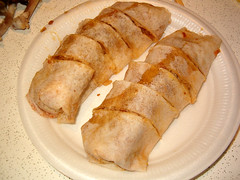
Popiah (Simplified Chinese: 薄饼; pinyin: bóbǐng or Chinese: 薄皮卷; pinyin: bópíjuǎn) is a Hokkien-style fresh spring roll common in Singapore and Malaysia. Popiah is often eaten in Fujian on Qingming Festival.

A popiah "skin" is a thin pancake made from wheat flour which is covered with a sweet chili pepper sauce before it is filled. The filling is mainly finely grated jicama that has been cooked with a combination of other ingredients such as bean sprouts, French beans, lettuce leaves, grated carrots, dried prawns, Chinese sausage, seaweed and shredded omelette. As a fresh spring roll, the popiah skin itself is not fried.

In Singapore and Malaysia there are "popiah parties," where the ingredients are laid out and guests make their own popiah with proportions of ingredients to their own personal liking.

Similar foods in other cuisines include Lumpiang Sariwa (Filipino), spring rolls (Chinese) and bò bía (Vietnamese) and fajitas (Tex-Mex).

Singapore - Newton Circus - Ice Kachang 红豆冰


Newton Circus - Ice Kachang
Originally uploaded by seraphim1970.

Ice kacang or Ais kacang (Chinese: 红豆冰; pinyin: hóngdòu bing; literally "red bean ice"), is a dessert served in Malaysia and Singapore. It is also known as air batu campur (ABC) in Malay. It is sweet-tasting and is ice primarily served with sweet flavoured syrup and jelly. The word Kacang (note that kachang is an old spelling) is a Malay word for bean, and the word "ais" is a translation of the english term "ice".

Formerly, it was made of only shaved ice and red beans. Presently, it generally comes with bright colours that often is said to sparkle on the ice, and with different fruit cocktails and dressings. Several varieties have also been introduced which contain aloe vera in some form or another, such as in jelly form. Often, a large serving of attap chee (palm seed), red beans, sweetcorn, grass jelly, cubes of agar agar and chendol form the base. Evaporated milk is drizzled over the mountain of ice. To cater to the palates of the modern customer, some stalls have even introduced novelty toppings like durian, chocolate syrup and ice cream. There are also versions that shun the multi-coloured syrup and are served with just a drizzling of gula melaka syrup instead.

Many Malaysian coffee shops, hawker centres and food courts offer this dessert. In Penang, the more popular places include Swatow Lane, Lorong Selamat and the Batu Lanchang Wet Market Food Court.

By tradition, all food courts in Singapore generally have at least one stall purely for desserts that would sell ais kacang by default. Ais kacang tends to be patronised by tourists and locals alike.

Singapore - Newton Circus - Orh Chien (Fried oyster egg) 蚝煎


Newton Circus - Orh Chien (Fried oyster egg)
Originally uploaded by seraphim1970.

Oyster omelette 蚝煎 is a Chinese dish which originated in Fujian. It is also popular in places with Fujianese influences such as in Guangdong, Hong Kong, Malaysia, Singapore, and Taiwan (where it is often sold in night markets).

The dish consists of an omelette with a filling primarily composed of small oysters. Starch is mixed into the egg batter, giving the resulting egg wrap a thicker consistency. Depending on regional variation, a savory sauce may then be poured on top of the omelette for added taste.